A cycling power meter is a device that measures the exact wattage output of a rider, providing objective data that isn’t affected by wind, fatigue, or terrain. Unlike heart rate monitors that lag behind effort, power meters give instant feedback on how hard you’re actually working, making them essential tools for serious cyclists in road cycling.
Key Takeaway
-
Power meters measure exact wattage output using strain gauges in pedals, cranks, or hub
-
FTP (Functional Threshold Power) is the maximum wattage sustainable for one hour
-
Training with power provides objective data unaffected by wind, fatigue, or terrain
-
Elite female cyclists typically have FTP of 4.5-5.5 W/kg
-
Power data enables precise training zones and progress tracking
What is a Cycling Power Meter and How Does It Work?
Strain Gauges and Torque Measurement Explained
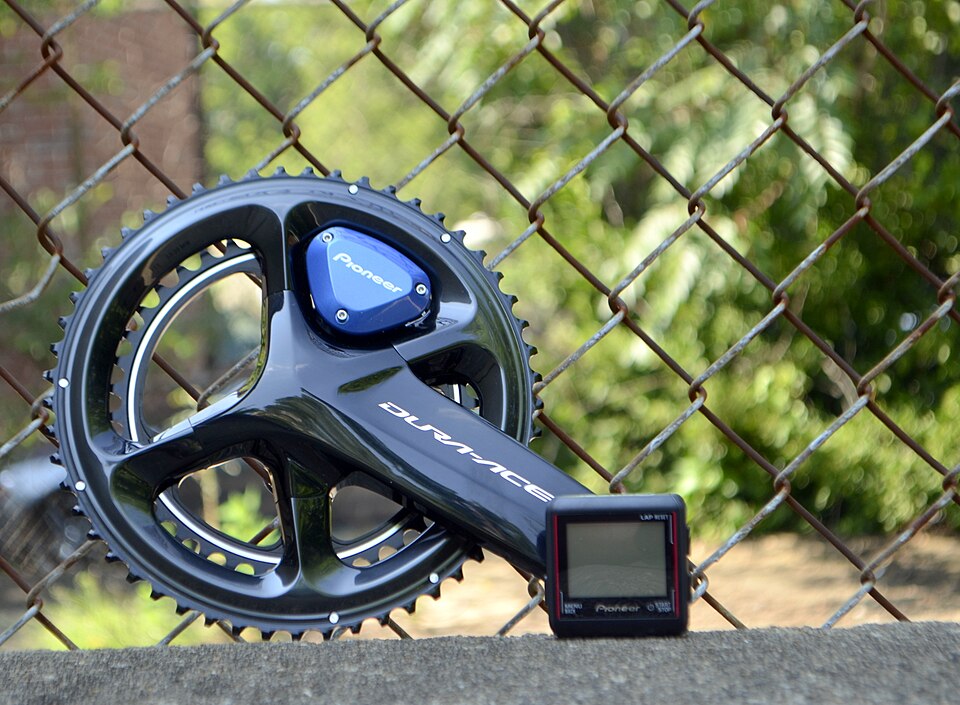
A cycling power meter uses electrical sensors called strain gauges to detect minute bending in the crank or pedal spindle when you push down. These strain gauges measure torque, which is the force you apply to the pedals. The system then multiplies this torque by your cadence (pedal revolutions per minute) to calculate real-time wattage. This provides an instantaneous, objective measurement of your power output that doesn’t change based on external factors like temperature or how tired you are. The technology works by detecting the tiny deformations that occur when you apply force to the pedals, converting these physical changes into electrical signals that the meter processes into wattage readings.
The strain gauges themselves are incredibly sensitive devices, typically made from a thin metallic foil arranged in a specific pattern. When the material stretches or compresses under force, its electrical resistance changes in a predictable way. The power meter’s internal electronics measure these resistance changes and convert them to force measurements. Most modern power meters use four strain gauges arranged in a Wheatstone bridge configuration, which provides excellent accuracy by canceling out temperature effects and other environmental factors. This sophisticated sensing technology allows power meters to detect force changes as small as a few grams, translating to precise wattage readings even at very low power outputs.
Power Meter Types: Pedals, Cranks, and Hub Options
-
Pedal-based: Sensors built into the pedal body or axle measure force exactly where it’s applied. These are easy to install and swap between bikes, making them popular for riders with multiple bicycles. Brands like Garmin Vector and Favero Assioma offer pedal-based systems that typically cost between $600-$1,200. The main advantage is portability – you can move them between bikes in minutes without tools.
-
Crank-based: Strain gauges are positioned within the crank arm or spider (chainrings). These units require specific cranksets but offer good accuracy and are relatively simple to interchange between compatible bikes. Popular options include Shimano’s R9100-P and SRAM’s RED AXS power meter cranks, which range from $800-$1,500. These systems provide excellent accuracy and battery life, often lasting 100-200 hours per charge.
-
Hub-based: Sensors are mounted in the rear wheel hub. These measure total power output from both legs but require wheel changes when switching bikes. Companies like PowerTap pioneered this technology, with hub-based systems typically priced between $500-$900. While less common now due to pedal and crank options, hub-based meters offer exceptional accuracy and work with any crankset or pedal system.
Understanding FTP and Training Zones
What is Functional Threshold Power (FTP)?
FTP is the maximum wattage you can sustain for one hour, which serves as the foundation for all power-based training. This single number determines your training zones and helps structure workouts effectively. Elite female cyclists typically have FTP ranging from 4.5 to 5.5 watts per kilogram of body weight, though recreational riders might be in the 2.5 to 3.5 W/kg range. Knowing your FTP allows you to train at specific intensities rather than guessing, ensuring easy rides are truly easy and hard intervals are actually challenging enough to drive improvement.
Your FTP represents the highest power you can maintain in a quasi-steady state without fatiguing. It’s essentially your lactate threshold – the point where your body produces more lactate than it can clear. This physiological marker is crucial because training just below or just above your FTP produces different adaptations. Riding at 90-95% of FTP improves your ability to sustain hard efforts, while intervals at 105-120% FTP increase your maximum sustainable power. The beauty of FTP is that it’s a single, measurable number that correlates strongly with endurance performance across all cycling disciplines, from time trials to road races to gran fondos.
Key Power Metrics: Normalized Power, IF, and TSS
-
Normalized Power (NP): Estimates the true physiological cost of a ride by accounting for surges and coasting periods, giving a more accurate picture than average power alone. For example, a ride with lots of hard efforts followed by coasting might have an average power of 200 watts but a normalized power of 250 watts, indicating a much harder workout than the average suggests.
-
Intensity Factor (IF): Shows how hard a workout was compared to your FTP. An IF of 1.0 means you rode at exactly your FTP for the entire ride. IF values below 0.75 indicate easy recovery rides, while values above 1.05 suggest very hard efforts. This metric helps you understand the relative difficulty of different workouts regardless of duration.
-
Training Stress Score (TSS): Measures the total workload of a ride, helping you manage fatigue and plan recovery. Higher TSS values indicate more demanding workouts. A 1-hour ride at FTP equals 100 TSS points. This system allows you to track your training load over weeks and months, ensuring you’re building fitness without overtraining.
Benefits of Training with Power Data
Instantaneous Data vs Heart Rate Limitations
Unlike heart rate, which lags behind effort (you might wait 30-60 seconds for your heart rate to rise on a climb), power is instant. This immediate feedback lets you adjust your effort in real-time. Power is also not affected by wind, fatigue, or caffeine intake, making it a more reliable metric for tracking fitness. While heart rate can be influenced by stress, temperature, and hydration status, power output directly reflects the actual work you’re performing, regardless of external conditions.
The instantaneous nature of power data is particularly valuable during interval training. When you’re doing 30-second all-out efforts, your heart rate might not even register the effort until the interval is almost over. Power meters show you exactly what you’re producing in the moment, allowing you to hit precise targets. This is crucial for structured workouts where the goal is to train specific energy systems. For example, VO2 max intervals at 110-120% FTP require exact power targets to be effective – something heart rate simply cannot provide due to its delayed response.
Precise Intensity and Progress Tracking
-
Exact intensity control: You can train at precise intensity levels, ensuring easy rides are easy and hard intervals are hard enough. This eliminates the guesswork that comes with perceived exertion or heart rate alone. For instance, recovery rides should be below 55% of FTP to promote active recovery without adding stress, while tempo rides target 76-90% FTP for building aerobic endurance.
-
Fitness monitoring: By testing your FTP periodically, you can track fitness improvements over time. Seeing your FTP increase from 200 to 220 watts, for example, provides concrete evidence of progress. Most cyclists retest FTP every 4-8 weeks, using the results to adjust training zones and ensure continued progression.
-
Pacing strategy: Power meters enable precise pacing during long climbs, time trials, and races, helping you avoid “blowing up” by maintaining sustainable effort levels throughout. In a 40km time trial, knowing your optimal power output (often 90-95% of FTP) helps you distribute effort evenly and achieve your best possible time.
The most surprising finding about power meters is that they can actually make training more enjoyable by removing uncertainty. Instead of wondering if you’re working hard enough or too hard, you have concrete data guiding your efforts. To get started with power-based training, test your FTP using a 20-minute time trial test, then use that number to set your training zones. You can find more cycling training resources and beginner tips at our beginner cycling training plan page, which includes structured workouts for all fitness levels.